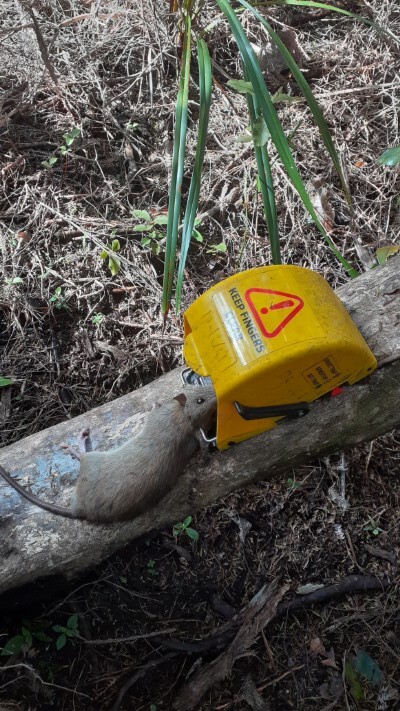
D-Rat Trap - Risk to Birds?

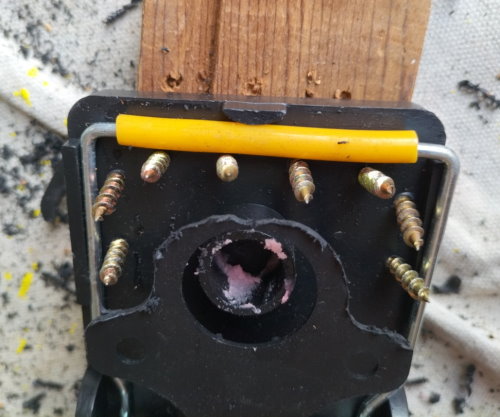
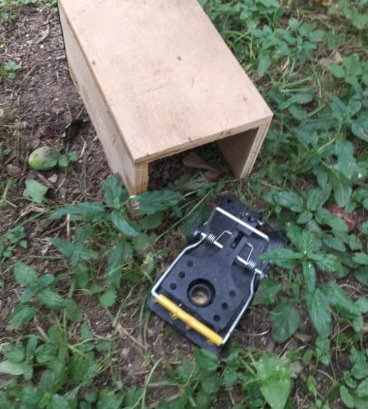
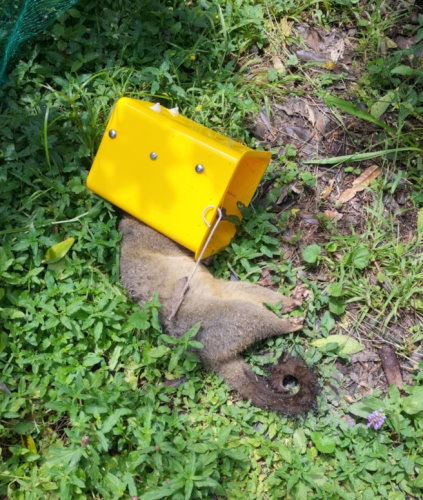
So I’ve modded the Snap-E in the tunnel to put the screws all the way through. I really, really need that trail cam to figure out what’s going on here though, got down there today and the tunnel trap was triggered with the tunnel flipped on its back and the trap some way away. This is the setup (tunnel upside down to allow a view inside):

IMG_20230101_183229

The only way I can explain this is if a possum got inside the mesh and pulled the setup apart, otherwise a rat would have had to go up the tunnel, trigger the trap, flip the tunnel over, and then pull the trap away. I left a bait bar off one of the feed stations, now with a trap inside it, leaning against one of the posts and this sure looks like rats rather than a possum (note also the half-chewed scraps that have fallen to the ground next to it):

I’ve also started a new thread on trap types and what works and what doesn’t, since there’s a lot of stuff that may be of interest to others hiding in this one.

The birds (one killed by the D-Rat right at the start, one annoyed by the flap-trap) were both thrushes, there’s a ton of them in the garden. I set up a bird feeder a few metres from the trees in the hope the birds would go for that instead of the fruit and refill it almost daily so they’re certainly taking advantage of it.

Will see how the modded Snap-E goes tomorrow.

Similar experience with the D-Rat trap, the only I got them to work was find a tree that is on 30 degree angle and put a bait trail leading up to the trap.

There are still not as effective as a Victor trap in a tunnel (based on catch rates), but you catch much more than having them vertical. I have only caught one rat on vertical placement.

Thanks…Gary

Ah, thanks for that! Based on willowflat_warrior’s comments I’ve moved two of the D-Rats to posts whacked in at about 45 degrees with a bait trail leading up to them, but after multiple mis-fires, meaning triggerings without catching anything, the rats appear to have learned to avoid them, the bait trail gets eaten but the trap is untouched.

I’ve now modified a second Snap-E and put it into a bait station to see if that helps, the other modified one in the tunnel is still being triggered every night to no effect, it ends up outside the tunnel with the bait gone and nothing in it.

IMG_20230102_183031

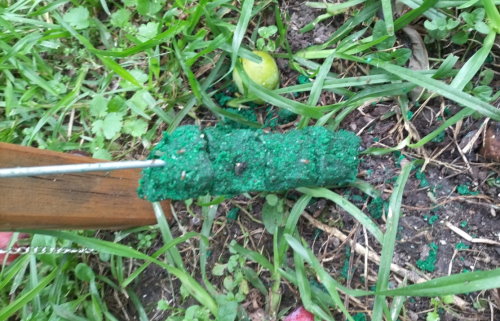
I’m still puzzled how rats are managing to do that, in one particular case they flipped the tunnel over and moved the trap some way away from it, but it’s almost certainly rats and not possums since the Timms is untouched and the rat poison from the bait station which I’d leaned against a post is disappearing at a great rate, this is one night’s worth (compare to the previous photo):

IMG_20230102_184459

Maybe that’s the trick, frighten them with traps that barely work and they’ll happily devour the poison next to them.

And another round of traps triggered with nothing in them, left it set inside the tunnel, in the morning it’s triggered, outside the tunnel, and with the bait gone:

IMG_20230103_183331

This is the modified-with-teeth one, not the basic trap. I’ve now got a second trap with the trigger bar cut down even more in the hope that they get far enough in that they trigger the trap once inside the kill zone. The only consolation is that they’re eating the poison moved out of the bait stations at a great rate, it’s almost gone now so the poison at least should do something to the population.

I think the reason why the modified Snap-E isn’t working, is that too much of the treadle was removed when you put the screws in. A rat would have to push on the lip with both paws to put enough pressure on what remains of the treadle, probably. What’s left of the treadle looks really flimsy, so it should break easily. Making a rectangular replacement treadle that just fits within the screw border could work, and if you made the treadle higher than a normal Snap-E one, by 10mm, for example, it should be harder for rats to avoid touching it when they lean in to reach the cup. You could also extend a DIY treadle, making it block off half of the bait cup, which would make it harder for rats (and mice) to eat lures. It would make it harder to get some lures inside the bait cup, but lures like smooth PB, Nutella, and mayo could go in a bottle with a snout and be squeezed inside. How would you make such a treadle? Beats me. Attaching a low-weight excluder of some kind on to an unmodified treadle that partially blocks the cup, might trap a few rats. You could try gluing one on, or for an experiment that doesn’t damage the trap, you might be able to use wire/string/blue-tack/a strong rubber band, to see if it makes a difference. Imagine if a treadle add-on was all it took to get them?

I think that you’ll have to make a row of teeth around the trap, instead of modifying the trap itself. A row of teeth through a wood/plywood base is you best shot.

Buying a T-Rex would be a wise idea. I’ve killed numerous rats with vertical T-Rex’s, so they could save you a lot of time, money, and frustration. They usually cost $10-12. Mine have lasted a long time, so the cost per year of using one is low.
In 2022, I killed 49 rats with my T-Rex’s and 7 with my Snap-E’s. Almost all of the lure-consumption out of the T-Rex’s was from mice, but rats regularly left the Snap-E’s spotless (droppings evidence and teethmarks). Only a handful of times did T-Rex’s go off without catching rats or small rodents, but the ratio of kills to empty traps that had been sprung with Snap-E’s was at least 1:4.

Buying one of these traps might also be worth your while.
Times Up Metal Rat Trap - Household Pest Control | Mitre 10™
With this powerful trap, rats push a solid bait on the skewers as they try to bite into it. They’re useless horizontally, IMO, but they’re great when they’re mounted vertically. Small pieces of pork fat and small pieces of jerky both work really well for brown rats and mustelids, and pieces of dried apricot or other fruits should lure ship rats. It’s also way easier, and safer, to set when it’s mounted vertically. 100% metal, they can last for a long time in harsh conditions.

I’m not a fan of the Victor Pro, but trying one of them vertically would also be worthwhile. Tying a firm lure, like a piece of jerky or apricot on to a Victor treadle would make things harder for rats to eat or steal.

Keep soldiering on - it’s only a matter of time before you’ll be posting pics of kills.

Cheers.

Yeah, it was trial-and-error to try and figure out why they were triggering the trap without getting caught in it while waiting for the trail camera to arrive. Shawn Woods, trap supremo, has a video somewhere in his collection of a rat dropping a stick across a trap to trigger it and then eating the lure, but I haven’t found any traces of something like that, or rat-sized lockpicks or crowbars either, so until I get footage of what’s going on it’ll remain a mystery.

I’ve already got some T-Rexes on order, however due to the long holiday shutdown I don’t know when they’ll arrive.

In terms of modifying the treadle, that’s going to be tricky, problem is that the PE/PP that the traps are made of is essentially impossible to glue to, particularly in this case where it’ll need to withstand mechanical shock (you can get pricey plastic glue that supposedly works on PE/PP but it doesn’t actually work very well on those and probably won’t withstand a trap activation). Possibly use some M3 304 stainless bolts to attach a modified treadle to the back of the cut-back existing one.

In any case the problem isn’t rats not triggering it, it’s triggering it without being caught, see the previous photo, thus the move to a smaller and smaller treadle in the hope that they can’t trigger it until they’re well inside the kill zone.

Grab some Fenns or DOC150 and put these tricky rodents out of their misery once and for all :slight_smile:

I like the comment about lockpicks and crowbars. It certainly feels like they’re using tools sometimes!

I’ve also had difficulty gluing things to plastic, and drilling isn’t always an option, due to the risk of thin plastic cracking. It’s bloody awkward, but using wire may be required. Tying a piece of a firm lure, like dried fruit, a firm piece of candy, or a piece of jerky, to the front of a T-Rex treadle might be a good thing to try, especially when they’re mounted vertically. Put in in the middle of the treadle, and then a loop from the lip of the hole above the bait cup to the front. In order to sink their teeth in, rats will have to put a decent amount of pressure on the treadle with their snout and/or paws. Because the lures are tough, mice, insects, and invertebrates will take a long time to eat it.

Jerky would be a good, hard-to-eat lure. In theory, it should be more effective at trapping brown rats, given their dietary preference for meat, but I’ve killed at least 50 ship rats using Goodnature’s Blood Lure (but it’s probably a much higher number) in my snap-traps, so firm, dried fruit, or candy may not be necessary (but rotating lures is a good technique). Goodnature’s lures aren’t eaten by ants here, which is a huge plus, and I’ve never found any evidence that larger insects or invertebrates eat it.

Dried fruit, like apricot, should be effective, and licorice All-Sorts cut in half, to reduce their weight and size to attach them to a treadle. If they eat All-Sorts, it should take insects quite a while to ruin them. There are quite a few gummy and hard candies that should work, instead of All-Sorts. A wide range of animals like anise, the substance in licorice that gives it its distinctive smell. Dried apricots should be more attractive to insects, but they’ll last a while, compared to soft lures like PB, Nutella, etc.

Regarding licorice as a lure, I knew a guy in Southland who used All-Sorts to trap possums, and he racked up impressive totals with it. This poses a problem in terms of possum interference, as do dried apricots, but they can both be used in Timms, and other possum traps with skewers, so placing a possum trap at the base of a trunk/post, or mounted vertically, below a rat trap, would be a good idea. Trapping expert Cam Speedy recommends placing traps targeting different species at the same site, in order to increase interaction-rates.

Once again, good luck! I hope the mini-treadle works.

Three days of nonstop rain may have solved the mystery, or at least, like finding a fish in your beer, provided strong circumstantial evidence for what’s going on: Went down there today in the rain and the two posts I’d whacked into the rock-hard ground to create a 45-degree rat ramp had both been pushed over in the now very-soggy soil. The only explanation I can think of is that a possum walked past the Timms traps and somehow got though the mesh around the trees even though there’s no obvious gap or hole in it (the rain discouraged a lengthy survey). The trail cam arrived earlier today so I’ll be able to confirm tomorrow. In the meantime I’ve rebaited one of the Timms with a cinnamon’d apple and the other with peanut butter just in case it’s more attractive than the same bait in the rat traps.

I think you’re right about the poles. I can’t wait to find out what the trail cam shows.

A big advantage that cinnamon-coated apples have, is that rodents rarely eat them. Here, mice and rats nibble them perhaps 1% of the time, and that’s in winter, when their food supplies are low. The one time that a ship rat decided to really sink its teeth into a cinnamon apple, I trapped the bastard. It ranks among the largest ship rats that I’ve ever trapped, so smaller ones might not spring a Timms. You could experiment by changing the sensitivity, to see if medium-sized rats are trappable.
Cinnamon has also kept insects and invertebrates away for me, too.

The problem with using PB is that interference levels should soar, because so many species like it. You could try spraying the PB with white vinegar, because insects and invertebrates dislike the acidity, whereas rats and possums love the smell and taste of vinegar. It just occurred to me that sprinkling some cinnamon on top of the PB might be a good combo. I have to re-lure my possum traps today, so I’ll see what happens.

I’ve killed 3 large brown/Norway rats this year in Timms, once I started using thick pieces of pork fat from the edges of pork steak or a roast. I (very carefully) make an X cut into it, because skewering it on a Timms is impossible without them. Rats and mustelids love fat, so it’s a great lure to use, and its firmness forces rats to really sink their teeth into the fat. Mice and small rats can nibble at it, but they usually only eat a small amount per night. I haven’t trapped a ship rat using pork fat, yet, but it’s possible. I dunk the fat in vinegar for about 5 seconds, because this gives it temporary protection from insects, including blowflies, and mould.

FYI, I learned a few months ago that I’d been luring my Timms incorrectly. I’d been using half a small apple, when I should have been using a thumb-sized piece, and I learned that smaller pieces should be skewered horizontally.

I actually had problems with rats going for the apples previously, every night the Timms had been cleaned out and roughly every second night the entire contents of the possum bait station was removed, which is why I was so sure it was rats again. Since it’s bucketing down again I haven’t done much because the rain is washing everything not under a roof away, got the Timmy on a half-round at 45 degrees which finally makes it possible to arm as easily as the ground-based Timms is, both with well-cinnamoned apples and the trail cam covering the area.

So the amount of circumstantial evidence that the main problem is actually possums just increased quite a bit:

possum

That was with willowflat_warrior’s cinnamon-apple trick, thanks for that! Got it the first night I used cinnamon, this was (presumably) one of the ones that had walked straight past the Timms trap line in the past and got through the mesh cage around the trees to attack them. I assume there’ll be a few more, will be resetting things tonight.

If dogs and feral cats aren’t a problem scavening dead possums, leave their bodies for 1-2 nights at the trap where they were killed. Apparently, the presence of another possum at a trap increases the chances of them exploring the trap. Keep killing the bastards!
All hail cinnamon!

What have your results been lately?
I hope that the cinnamon has continued to work.

Any kills with the highly-modified Snap-E?
Have the T-Rex’s arrived, yet?

Cheers.

I’ve been away for a few days so haven’t checked the rat traps but nothing in the possum traps although there were signs of new possum damage around the rat traps a few days ago when I last looked. The T-Rexes have arrived and are set up, but again haven’t been around to check them yet.

The trail cam has been a bit of a disappointment, the lens is too long for closeup stuff unless all you need to cover is a very narrow field of view, but according to other reviews too short for field work where you’ve got deer some way off, it seems to be a bit of an unhappy medium. I need to check the footage again tomorrow but so far the only revelation is that there’s at least one pukeko down there which I’d never seen here before, and neighbours who have been here in some cases over thirty years had never seen either. If I hadn’t seen the video footage I wouldn’t have believed it, I’ve never seen one in at least a 5-10km radius of here.

I guess I asked about your progress (fingers-crossed) too soon. I hope that the T-Rex’s perform well.

Sorry to hear about the trail cam. Buying one is on my to-do list, but there are too many to choose from!

If it’s just the one pukeko, it’s possible that it’s lost.
A magpie, which I think has just reached adulthood, decided to join our family about 10 days ago, but it doesn’t appear to have caused any trouble. It’s getting tamer by the day, only flying off when you get about 4m away. If you couldn’t see it, you wouldn’t know it’s around, because it’s so quiet.

Cheers.

Reviewed the footage and another one of the possums had torn a hole in the mesh and got in, and the following day an army of birds followed. Argh! Unfortunately the camera didn’t catch it in the process of getting in so I’ve relocated it to the other side, which is a bit iffy since I can’t move it back far enough to capture the entire area of interest due to trees. We’ll see.

I’ll make a separate post about the trail cam, or start a thread if there isn’t already one.

1 Like

Thoughts on “Making the Better Rat Trap”.

I found this old discussion and thought I would revive it, and give some updates on what my company has been doing

Like many on here I have tried in vain to make the plethora of snap traps do more than create a catchment of wised up rats. All the snap traps have issues - they often catch badly and often just scare off the rats, many with broken limps or a sore nose. My company works in R&D and five years ago we teamed up with a company called TrapTools to “make a better rat trap” - how hard can it be? Well the truth is quite easy - its called poison. But given some don’t want to use it - or cannot around crops or food or pets or whatever second best its called a DOC 150. SO the issue lies not with it being hard to make a better trap but its hard to make it small, light cheap and safe - the wants and desires become exclusive. So still determined to give it ago - five years ago with TrapTools providing engineering and us the field work, this is where we are at:

We started our project investigating what was available. The best of the lot have passed a NAWAC for shiprats and one has passed with mods for Norway rats also. (you can look up NAWAC on line). I’m not convinced by any of those passes since I have bad catches on all.
I define "bad catch " as rats I kill myself next day or find caught by one leg or by a nose. There is a another category we include in our research stats and that is set-off no animal. Some have left a tail or a leg or some fur and some have the trap dragged by cats or themselves to the hole and are gone, some are just set off empty in place. We constantly had around 35 % all traps which were set off - set off empty. With no proof I believe most of those are probably due to missed or pulled free animals, and that was the starting point of our research program. Many “bad catches” and many set offs no animal. The technical issue was to solve this using the standard traps, easy !!

So we set out to do these things systemically:

We treated the project as we would a factory ( we are from science and engineering) - we wanted to improve productivity ( catches) and quality ( how well caught ) and reduce rejects ( misses), with that in mind. We knew we would not find a miracle cure but were looking for a percentage gain in the three criteria.

Stage 1 Test the traps in the lab to see which one we should use of the cheap light traps - we exclude doc traps which work anyhow.

Stage 2 Then we took this one best trap and worked on the box design to:

Reduce the % set offs with no animal.
Improve the catch quality ( we set up criteria for how well caught)
Increase the total number caught.

The “control” or standard setup we used to compare with was a wood rat box set up exactly as we observed being used all over NZ, as made by councils and men sheds in every town.

And five years later and lots of money into injection moulds we have a half reasonable box. We are now working on improving it of course but the first two trials indicate about 30% more rats ( 200% more mice but thats another issue) and sets off no animal down from 35% to 10% of total offs.

Sorry if the numbers are spinning but basically we caught more and missed fewer. The “catch quality” or how we caught them has been harder to analyse, but we are working on the numbers, and waiting on another trial, see below for comments.

The trap we settled on after lab testing was the Victor professional (VP) - it has about 1.5 the whack energy of the next best. The whack is dependant on the amount of energy in the setting and the long 180 degree set of the VP means more potential energy to convert to kinetic energy and so makes it a good trap to work with to to make better. I also quite like the fact is wood and metal - so can be fully recycled - but that was not part of our criteria.

The design of the box was interesting we starting with some old research indicating better entry rates with a certain side entry design so we worked on that to make it fit the bird criterial and to take the swing of the VP. Then we worked on reducing the number of leg forward approaches and restricted the height to stop high head approach.

Anyhow I can go on - but we would like people to try it after the work that has gone in. Potentially this is Mark 1 but we need to sell some before we make all the changes we now want to make. I do not think we can improve the catch rates much more or improve the misses or set offs with no animal. Most of the remaining ones I suspect are animals knocking the box or mice being missed within the swing of the arm. So any changes from here on will be more to do with usability of the box and only small improvements in catch rate or quality can be made…

Last thoughts now the project is over:

If we are going to rely to a degree on mechanical traps to do some of the predator control work we should do our very best to do it well, even if that costs more for the devices. Buying the cheapest is not an ethical choice but we need more data to make informed choices. Rats matter just like cats , and human time counts too plus it there is no point in training up a heap of intelligent rats that will never come back after a bad trap-trip.

We started way back before the project using e-snap and t-rex and when we shifted to the VP we not only had better catch quality and more catches but also we caught smaller rats. I think with little proof that the lower trigger force of the VP means we now catch the juveniles and Kiore. ( I have not included trip forces in this discussion but we lab-measured that too) I am not anti poison, but using this better box system and a few extra traps along streams I am hoping to do my own catchment on Aotea poison free. Or maybe one pulse per year if need be.

I have not mentioned trap maintenance or replacement when old - but that is a real issue, after 8 years crouched down looking into other peoples trap-boxes I can say many (most) don’t oil or replace traps often enough. They are cheap nasty devices but can be improved by care and routine replacement when the springs decay. I know waste is bad but the animals deserve respect.

The issue of “catch quality” was complicated… We have also tested long life lures to end of the lures viable life and then we had a lot of run throughs. These are animals that enter the box and are not focused on the bait since it has lost odour - instead they run for the light at the other end and are caught mostly badly. So for “good quality” catches the baits must be viable. We are running some more trials to see if we have improved catch “quality”. We catch a lot of smaller animals with the VP traps and they are not really made for that - so the problems are not solved yet!

So after all that:

Even if you don’t want a box ( I’m sure you do !) - have a look at www.rattek.com and comment.

  • I can take the bad with the good

The other product is a lure out of VUW but thats whole other story, for another long weekend.

Finally - making a better rat trap is not for the faint hearted - I don’t recommend it but Im sure that won’t stop many more people trying - it probably all started with drawings on a cave wall somewhere.
1 Like

I’ve used similar enclosed snap traps and they can work well on rats. Non target bird risk is usually low when the entrance size is right and the trap is placed properly, but I’d still be cautious in areas with curious native birds. I’d probably test a few first before deploying 50.