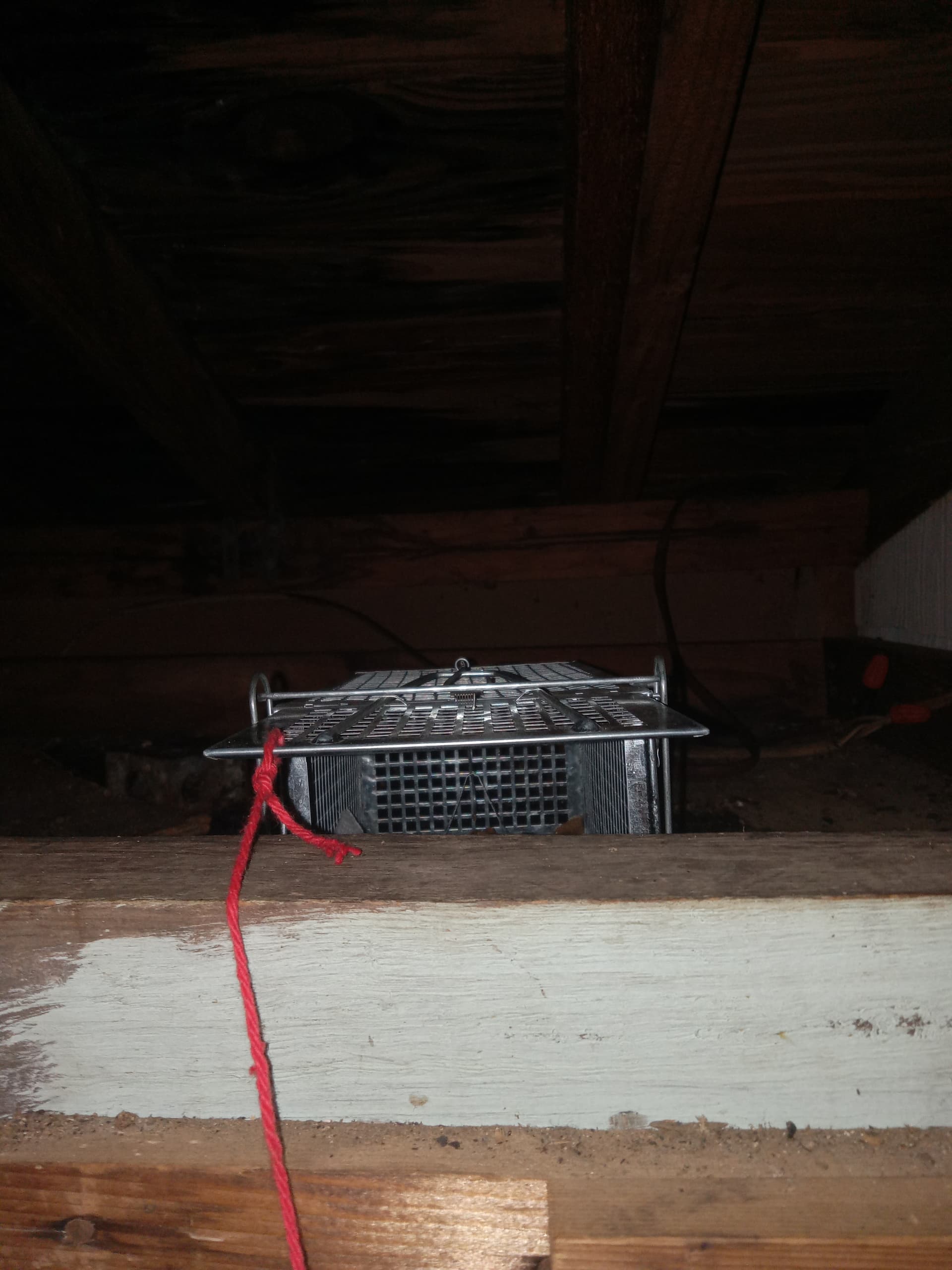
Trying to remove rats humanely, now they're eating holes in roof, help

I’m really trying to work with my stepdad, being an owner of 3 rats and a mouse and I can’t bring myself to bring poison bait. I’ve been trying to use humane no-kill traps and the rats just haven’t been getting caught in them lately. My stepdad found a hole on the roof and its becoming an emergency to do something but we don’t want to bring harm and suffering to any of them. Please help. Am I doing something strategically wrong with the humane catch traps? Could the trap not be triggering from the rat?

I’ve been trying to use a lot of normal rat food but I think I need to switch to hot dogs and peanut butter.

I’ve read that no-kill traps are only effective when you release animals a significant distance away from your house, otherwise they’ll make their way back. Try to find a solid, reasonably heavy lure for your trap, because this will make it harder for a rat to avoid putting weight on the treadle or not putting enough on it. A large walnut might solve your problems, because rats love them. If it’s mice that are eating your lures, they can’t interfere with an intact walnut.

No-kill traps are a bad idea. Releasing rodents in inhabited areas has the potential to create a problem for somebody else (your roof to theirs) and releasing them in uninhabited areas will place even more pressure on wildlife. Your reluctance to kill rodents is understandable, but humanely killing rodents is the best solution. I have no desire to kill any animal, but it’s a necessity in this country.

Rodenticide is inhumane, expensive, you can poison non-target species in the area, like pets or ruru/morepork eating small rodents, and you can end up with dead rats dying where you don’t want them to, which is an absolutely terrible problem to have if they decide to die in your attic. If you use them properly, mousetraps and rat snap traps are the fastest, easiest way to go, and NAWAC tests them to gauge how humane they are. Buy the most humane model(s) on the market and start trapping. When it comes to finding trapping advice from people who know what they’re doing, you know where to look.

Good Luck.

1 Like

Hi when you say NO kill traps I guess you are talking about cage traps ? really hard to work out what might be going on without being able to see the traps etc, Walnut season now I generally drill a small 2mm hole through the walnut and tie it in place with some fine .5 mm wire so the rat has to struggle and move around to get it giving more time for the trap to activate.
but I agree with what willowflat says if you are doing a catch and release then you are not going to get rid of the problem.
I don’t like to kill things but as long as it is humane I don’t have too much problem with it, over more than 20 years I have had to pick up predated Kiwi and Kokako and watch video of ship rats eating eggs and chicks from nests.
Best suggestion is to find a friend who will do the job or just call in the professionals to sort out the issue

1 Like

If a trap (either live trap or kill trap) suddenly isn’t catching well, it would definitely be worth checking the trigger weight and calibrating if necessary. Find some small objects that you can carefully lower onto the treadle plate (using a piece of string or similar to keep your hands clear), and weigh them - digital kitchen scales will usually do the job. I usually use a bundle of old socks, but other options include washers and sections of cut-up hosepipe.

Depending on whether you want the trap to trigger for both mice and rats, or just rats, find out an approximate weight for a juvenile individual, then get your object(s) to match that weight. Lower it as gently as possible onto the treadle plate (to mimic a cautious rodent climbing on very slowly) and see if the trap triggers. If it doesn’t, you need to adjust the trap to be more sensitive.

It’s also possible that the remaining animals have become trap-shy (especially if they have already been caught once), in which case you may need to change trap types.

I get where you are coming from on the no-kill front, it’s really tough to target a species that you’ve had as a companion animal. I would definitely suggest that you should seal any access points you’re aware of (like holes in the roof) to prevent animals from returning.
The “release” part of live-trapping is a bit of an issue, however - s52 of the Biosecurity Act prohibits releasing pests, so if your local council’s pest management plan lists rodents as a pest animal, it might actually be against the law to release live-trapped animals. Predator Free 2050 is currently trying to remove all wild rats from NZ, so I’d be surprised if any local councils don’t list rats as a targeted pest animal.

One option you could explore is to check with local vets in the area or the local SPCA to see if they’d be willing to assist you with humanely euthanising live-trapped animals? There may be a fee involved, especially if you are asking for assistance with multiple animals, but this will depend on the organisation.

2 Likes

One trap above the water heater / appliances, One trap in an alcove in the celing preceding the door to my room and another in the crawlspace above the bathroom door. I can only post one attached media at a time.

We have a wildlife rescue thats humanely euthanized babies we’ve found. I’m in Florida and they’re considered pests but so far Floridians. If I was the rat I would want my life spared. My gratefulness for having my life would far outweigh the inconvenience of the legal status of my existence

Our traps have worked successfully before many times but for some reason these rats we haven’t been able to catch are particularly cautious or the mechanism isn’t working properly. So we’re going to examine the traps. Theres some time before we go to snap traps. Which brands of snap traps are the most humane?
We have regular roof rats

Hi in your first post you said the traps were not triggering so what I will mention is not the problem but can be a factor when you do catch a rat.
The loose wire at the top of cage that runs from one side to the other needs to be on the door side of the wire loop. In the photo it looks like it is on the back side. It’s purpose is when the trap is set off the wire drops down to lock the door in place

A couple of weeks ago just as I picked up a small cage trap the rat desperate to escape pushed on the corner of the door and escaped because I had forgotten to lift the locking wire to the front when I set the trap
cheers

As you’d expect, there is a lot of debate about which snap trap models are the best. Each one has its pros and cons.

My personal favourite is the T-Rex (the Tom Cat is the same). It’s an easy trap to operate, it’s strong, it can be used horizontally or vertically, and its teeth are very good at holding rats in place. As with any trap, rats can escape with injuries, but in my experience, this is very rare if you use the right techniques.

The one weakness of the T-Rex is that it is hard to give rats a sample of the lure that you’re using, because rats can’t access the bait cup when the trap isn’t armed. I work around this in 2 ways.
First, I fill up the bait cup and close the trap. Mice can get inside an unset trap and eat the lure. This “seasons” a trap with mouse activity, letting rats know that mice have been finding something good to eat inside the trap, and that they haven’t been harmed by it.

Secondly, I smear T-Rexes with the lure that I’m using on top of the trap and in the immediate area. Rats come to associate the trap with a safe source of tasty, nutritious food, so when you do arm your traps with the lure inside the bait cup, they aren’t put off.

Note: Both the T-Rex and the Tom Cat have passed New Zealand’s National Animal Welfare Advisory Committee test for roof rats.

An alternative to using snap traps, is the Goodnature A24 automatic trap, which uses gas to fire a bolt which strikes rats on the skull. The A24 has also passed NAWAC tests for roof rats. Unlike snap traps, the A24 is active 24/7, can kill a large number of rats quickly, and you may not have to handle carcasses, due to scavenging. If you do, a cheap pair of tongs work great. The initial investment is high compared to snap traps, but it has a long operational life and it’s cheap to operate. While the A24 was designed to kill rats, stoats, and weasels, it can also kill mice. It is not as reliable as mousetraps, in my experience, so you will definitely need to purchase some. In most household situations, 4 high-quality mousetraps would suffice, provided they’re checked 1-2 times per day.

Regarding trapping, in general, do you have any experience?
The advice of the trappers on the forum will allow you to solve your problem humanely and efficiently.

Cheers.

We have 4 Victor super kill traps set up and so far they aren’t taking the peanut butter we’ve placed.

We’ve given them a week or so of feeding without trying to trap and its been 1 day since the traps are placed, making me anxious.

Hi
We are interested in sending you some different lures. Let me know if you would like to offer them another option.
steve

I’m interested. The trap has still been largely ignored. One rat set a trap off and managed to get away. We’re going to try the old fashioned wood victor traps because we’ve had success with them in the past. We think the strike area of the bar isn’t wide enough to have a good probability of getting a rat thats dextrous.

HI - thanks for that contact.
Please email us on admin@rattek.com
Steve

If you haven’t already, try to position traps parallel to runway features like beams and walls, particularly near suspected entry/exit points or where droppings are found, and if you don’t have purpose-made trapping tunnels maybe place found objects like bricks, boards, etc. beside/over the trap in a tunnel shape to encourage the rats to approach the trap at the correct orientation for a clean kill. Sometimes people will place two traps in a tunnel, one facing each end, so that there is no way to the lure except over the treadle. This also allows you to put a larger amount of lure between the traps (in case the trap itself doesn’t have much space for lure).

If the rats aren’t going for peanut butter, another commonly used lure is mayonnaise. Try not to get it on any wooden parts of the trap (or attic) though, soft lures tend to soak into the wood and then go mouldy. If you go with a two-trap set-up, you could place mayo inside a bottle lid between the traps - when the lure gets too old, you can just throw out the whole lid rather than trying to get mouldy lure off your trap or tunnel. Ditto if you use fish (tuna and salmon are both strongly scented) or meat lures.

I’m still here collaborating with my stepdad over this.

We really want them to go for the cage traps. We’ve ordered tomcat gel lures and plan to try some more humane no kill traps. Most of them seem to have gone, one died suddenly in our hands and we didn’t know what happened to her because it wasn’t a trap. Theres one area they’ve nested now where they have a highway to reach the rest of the house and if we put a trap there they should have no choice, unless they’re able to get food from elsewhere .

8531f54d01fa49ef7e5a32675dbf9d6d

When it comes to using cage traps for rats, it’s wise to allow them to explore the cage and eat a lure before the trap is armed. Some traps have a way of allowing you to keep the cage door open without the trap firing, but you may have to use something like a zip tie to hold a cage open for 1 or 2 nights. To ensure that the cage receives plenty of traffic, don’t skimp on the lures, and use several at once to pique rats’ interest. Your Tom Cat lure, plus peanut butter, Nutella, etc. Rats love mayonnaise, so if you can find a small container for some that won’t get your cage dirty, I highly recommend using it. If there’s room in the cage, a small tin might work. Using a few stones to weigh down the tin would be wise to anchor it. Putting a small tin of fish or pet food inside the cage is another option, but cats and dogs will be attracted to the tins, obviously.

Rats are always looking for food(s) that they can cache in their nests, so a solid lure should be very appealing to them. Rats that don’t feel safe to enter a cage to eat a lure inside it, may take the risk to go inside it, if there’s a high-quality food that they can remove from it. An excellent option for a solid lure is walnuts, which are one of rats’ favoruite foods, so get some of them if you can.

If you can get any, crack a walnut in half, to disperse the scent of the walnuts and to make it easier for rats to sample them. Once the halves have been taken, place a whole walnut in the trap, because the desire to eat another one, plus the appeal of removing a walnut, should be irresistible. Other nuts will work, too, as will chocolate covered nuts, like almonds or peanut M&M’s. Ship/roof rats also like fruit. In a cage trap, grapes are an option to consider. When the trap is armed, put a small bunch in it, 3 or 4 connected by a stem, because it’s possible that a smart rat could remove grapes one-by-one.

Regarding the rat “highway” that you’ve discovered, that should be an excellent site for cages and snap traps. Placing your traps/cages facing both directions is a good way to trap 2 rats the same night.

In order to direct rats to your cages and traps, you should try to make what’s referred to as a “funnel”. This is where you modify their route(s) by using materials to aim rats towards your traps/cages. Position the traps/cages parallel to the wall(s) and use a plank of some wood/ply, or a similar rectangular object, to create another wall that extends beyond the traps/cage (1 metre/3 feet either side or more), ideally. Rats will be less likely to avoid your traps/cages this way, because they don’t want to take the risk of exposing themselves by going to the other side of the second wall (unless there’s a safe alternative a short distance away, like a fence, hedge row, etc. that’s also good cover.

It’s also very important to make sure that your cage(s) are steady, because rats prefer to walk on stable surfaces. When necessary, I’ll use a brick or rock to anchor my tunnels to make sure that rats, stoats, and weasels feel safer entering them.

The rat that died in your hands may have been poisoned by a neighbour performing pest control or it may have been injured by a trap and escaped, dying of its injuries later on. One of the reasons why I prefer the T-Rex/Tom Cat is that the teeth are very effective at preventing injured rats from escaping into the wild, where they may suffer an inhumane death. Also, bear in mind that wild rats typically have a short lifespan. If it was already on the verge of death, the stress of being handled by humans may have caused it to die faster. Even a dying rat might try to give you a bite, so be sure to wear a pair of strong leather gloves to limit the chances of an injury and to reduce the chances of contracting a disease. Tongs are an excellent way to handle dead rodents.

Good luck.